
How to Choose Pick and Place
Pick and Place Machines: Types, Leading Brands, and How to Choose
Introduction
For electronics manufacturers evaluating SMT assembly lines, understanding pick and place machine categories and the strategic choice between established international brands and emerging Chinese alternatives is essential. This guide breaks down machine types, compares key players, and provides a practical selection framework.
Types of Pick and Place Machines
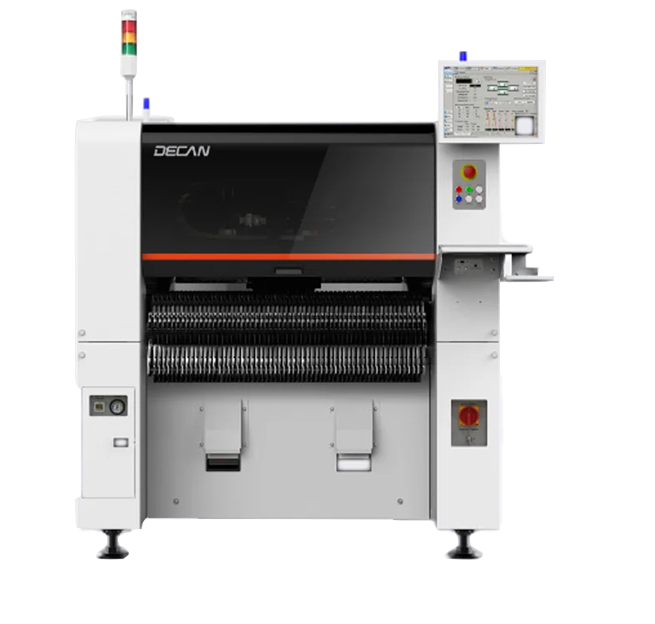
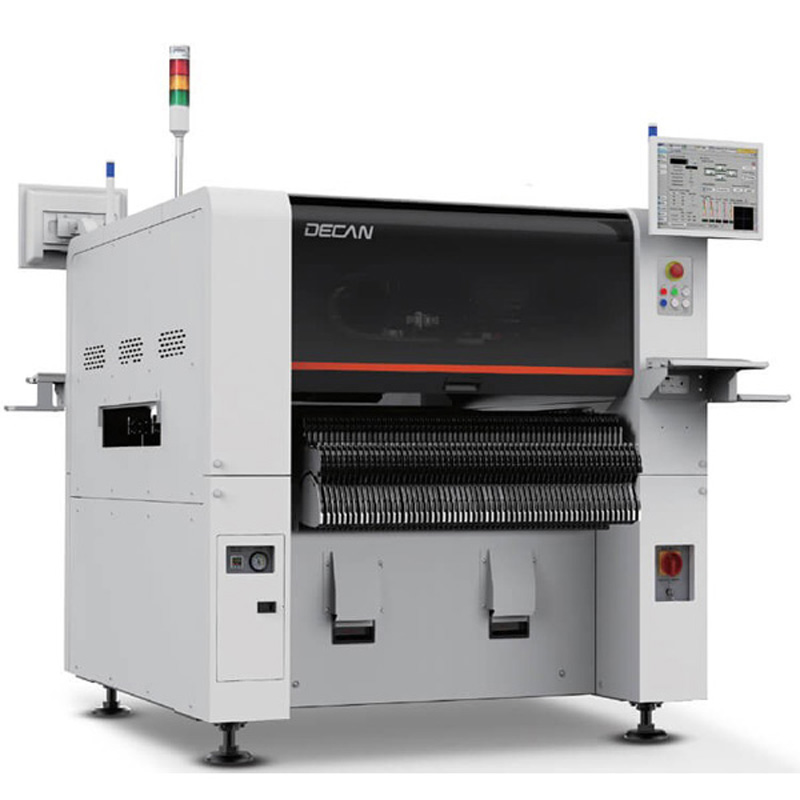
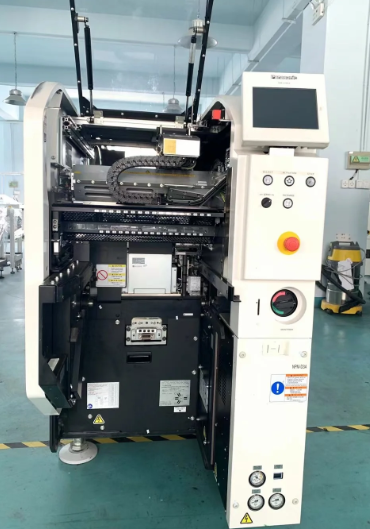
Pick and place machines generally fall into three functional categories based on their design priorities .
Chip Shooters (High-Speed Machines) are engineered for raw throughput on simple components like resistors and capacitors. Using turret or revolver heads, they achieve 20,000 to over 100,000 components per hour (CPH). The trade-off is accuracy—typically around 70 µm—and limited component size range (up to approximately 20 mm). They are unsuitable for fine-pitch ICs .
Flexible Placers (Precision Machines) prioritize accuracy over speed. They run at 6,000 to 40,000 CPH but achieve placement accuracy down to ±25 µm. These gantry-style machines handle everything from 01005 passives to 150 mm connectors, including BGAs and package-on-package devices .
Modular / Hybrid Systems combine both capabilities, allowing manufacturers to add heads or gantries as production scales. They are ideal for high-mix environments where a single line must handle both simple passives and complex ICs .
Line Configuration Insight: For mixed boards, the optimal setup typically pairs a chip shooter for bulk passives with a flexible placer for ICs. Line throughput is determined by the slowest station, so balancing the two matters more than any single machine‘s headline speed .
Leading International Brands
The global market is dominated by established players with decades of engineering refinement .
ASM Pacific Technology (ASMPT) holds the largest revenue share, followed closely by Fuji and Panasonic. Yamaha and JUKI compete through modular platforms balancing speed and flexibility, while Hanwha targets EMS and automotive applications .
These brands offer proven reliability, extensive process traceability, and global service networks—but at premium price points and with higher maintenance costs.
The Chinese Brand Landscape
Chinese manufacturers have evolved rapidly, creating two distinct tiers .
Mid-Tier Value Players (e.g., Yitong, Changheng, Kangpute) focus on cost-effective solutions for LED lighting, home appliance control boards, and power supplies. Their key advantages include localized service, fast response times, and significantly lower maintenance costs. Yitong‘s flagship models achieve speeds up to 98,000 CPH with ±0.02 mm accuracy, powered by proprietary magnetic levitation motors .
High-End Challengers (e.g., Yitang, Luyuan, Muji) target automotive electronics, industrial control, and medical devices. These manufacturers emphasize self-developed algorithms, linear motor drives, and precision approaching ±25 µm . Luyuan’s dual-arm platform reaches 90,000 CPH, while Muji claims over 96% self-sufficiency in core components .
How to Choose: A Practical Framework
Step 1: Define Your Production Reality. High-volume, low-mix production favors speed-optimized machines. High-mix, low-volume operations demand rapid changeover and flexible component handling .
Step 2: Audit Component Requirements. Identify your smallest components and most complex packages. If you place 0201 passives, you need at least ±30 µm accuracy; for 01005, you need ±25 µm or better .
Step 3: Evaluate Total Cost of Ownership. Beyond purchase price, assess feeder systems, spare parts availability, service response time, and programming software ease-of-use. Chinese brands often excel in service proximity; international brands offer more mature ecosystems .
Step 4: Plan for Growth. Modular architectures that allow adding heads or gantries prevent premature equipment obsolescence .
Step 5: Demand Real Data. Request actual throughput (UPH) under production-like conditions, not just datasheet maximums. Real-world performance typically reaches 40–70% of theoretical CPH .
Final Recommendation: For cost-sensitive, high-volume production of consumer electronics or LED products, Chinese mid-tier machines offer compelling value. For automotive, medical, or aerospace applications where reliability and traceability are paramount, established international brands or Chinese high-end challengers with verified precision are the safer choice.