
Why is 3D SPI indispensable for high-precision solder paste inspection?
Why 3D SPI Inspection Equipment is Indispensable for Modern High-Precision Solder Paste Inspection
In the fast-evolving world of electronics manufacturing, the miniaturization and increasing complexity of printed circuit boards (PCBs) have placed unprecedented demands on assembly processes. At the heart of surface mount technology (SMT) lies solder paste printing—a critical step that directly impacts the quality, reliability, and yield of the final product. As components shrink and board densities soar, traditional inspection methods have become inadequate. This is where 3D Solder Paste Inspection (SPI) equipment has emerged not just as an advantage, but as an indispensable tool. Its necessity stems from its ability to address the stringent requirements of modern electronics through precise volumetric analysis, process control, and defect prevention that two-dimensional methods simply cannot provide.
To understand the indispensability of 3D SPI, one must first appreciate the role of solder paste. Solder paste, a mixture of tiny solder spheres and flux, is deposited onto PCB pads through a stencil. After component placement, the assembly passes through a reflow oven where the paste melts, forming the electrical and mechanical connections. The quality of this solder joint is fundamentally determined by the volume, height, area, and shape of the paste deposit before reflow. An insufficient volume can lead to open circuits or weak joints; excessive paste can cause bridging (short circuits) or tombstoning. With components like micro BGAs, QFNs, or 0201 chip components, the margin for error is virtually zero. The pitch (distance between leads) is so fine that even microscopic deviations in paste can spell failure.
Traditional inspection methods, including manual visual checks and 2D Automated Optical Inspection (AOI), are severely limited in this environment. 2D systems capture only plan-view information—length, width, and XY alignment. They cannot measure what is most critical: height and volume. A 2D system might see a paste deposit that looks correct in shape and area, but it could be too flat or too domed, hiding a volumetric defect. Furthermore, 2D inspection struggles with low contrast, is easily fooled by reflections from the paste or board, and cannot reliably detect common but critical defects like insufficient paste volume or scooping (where paste adheres to the stencil aperture walls, resulting in a reduced deposit). In high-mix, high-precision manufacturing, relying on 2D is akin to flying blind.
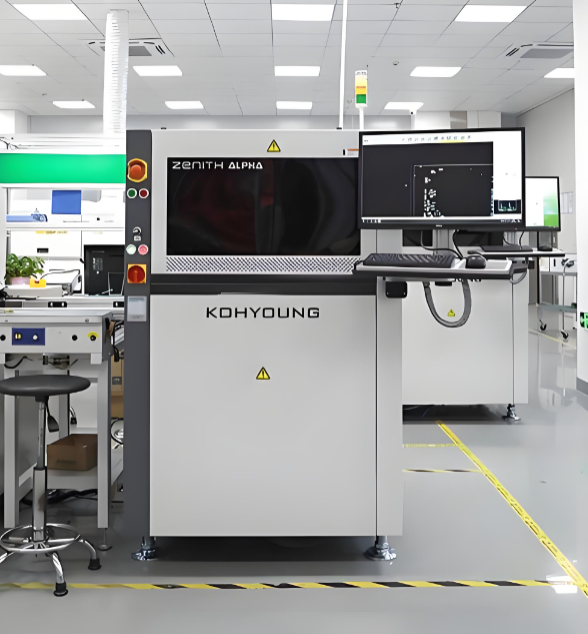
3D SPI systems solve these problems by adding the crucial Z-axis dimension. They typically employ one of several optical technologies, such as phase-shift profilometry, laser triangulation, or Moiré fringe analysis. A common method involves projecting structured light patterns (e.g., grids or sine waves) onto the board surface. Cameras capture the distortion of these patterns caused by the height of the solder paste. Sophisticated algorithms then reconstruct a detailed three-dimensional topographical map of every paste deposit. This map provides exact measurements of volume, height, maximum/minimum height, area, bridging risk, and coplanarity.
The indispensability of 3D SPI is anchored in several key technological and economic advantages that are critical for modern manufacturing:
1. True Volumetric Measurement for Solder Joint Integrity:
As mentioned, the solder joint's ultimate strength and conductivity depend on the correct volume of material. 3D SPI directly measures this parameter for every single pad. It can detect subtle variations—say, a 20% shortfall in volume—that a 2D system would miss. This is paramount for ensuring the long-term reliability of devices, especially in automotive, medical, aerospace, and telecommunications industries, where failures can have severe consequences.
2. Unmatched Process Control and Optimization:
3D SPI is not merely a final quality gate; it is a powerful process control tool. By providing real-time, quantitative data on printing performance, it allows engineers to fine-tune the SMT line proactively. For instance:
-
Stencil Wear & Clogging: It can detect a gradual reduction in paste volume from specific apertures, signaling stencil clogging or wear before it causes failures.
-
Printing Parameter Adjustment: Data on height consistency across the board can guide adjustments to squeegee pressure, speed, or separation speed.
-
Stencil & Printer Alignment: Detailed registration analysis shows misalignment between the stencil and PCB in X, Y, and theta axes, enabling immediate correction.
This shift from detective control (finding defects after they occur) to preventive control (stopping defects from happening) is a cornerstone of modern quality philosophy and is essential for achieving Six Sigma levels of quality.
3. Enabling Miniaturization and Advanced Packaging:
The industry's relentless drive towards smaller, faster, and more powerful devices has led to the widespread adoption of components with pitches below 0.4mm, ultra-fine pitch BGAs, and micro-LEDs. These technologies demand solder paste deposits that are perfectly formed. 3D SPI is the only in-line method capable of verifying that these microscopic paste deposits have the correct shape (e.g., a clean brick shape rather than a rounded dome) and are free from micro-bridges that are invisible in 2D. Without 3D SPI, the assembly of such advanced packages would be a high-risk, low-yield endeavor.
4. Bridging the Process Feedback Loop:
In advanced SMT lines, 3D SPI forms a vital link in a closed-loop process control system. The measurement data from the SPI can be fed back to the solder paste printer (and sometimes forward to the placement machine) for automatic compensation. For example, if the SPI detects a trend of low volume on a specific pad, the printer can automatically adjust its parameters for the next board. This real-time correction minimizes waste, maximizes uptime, and ensures consistent quality without constant human intervention—a necessity for high-volume manufacturing.
5. Economic and Yield Imperatives:
The cost of finding a defect escalates dramatically at each stage of production. A solder paste defect discovered and corrected at the printing stage costs pennies. The same defect, if it proceeds through component placement and reflow, can result in a faulty board requiring costly rework or even scrap. If it escapes to the field, it can lead to warranty claims, recalls, and brand damage. 3D SPI acts as the first and most critical defense line, catching defects at the cheapest possible point. By dramatically reducing defects downstream, it directly boosts first-pass yield, reduces rework labor and material costs, and accelerates overall throughput.
6. Meeting Stringent Industry Standards:
Modern electronics manufacturing is governed by strict international standards (e.g., IPC-A-610, IPC-J-STD-001). These standards define acceptability criteria for solder connections, which are rooted in the geometry of the solder joint. By ensuring the solder paste deposit is correct from the start, 3D SPI provides documentary evidence of process capability and compliance, which is crucial for audits and customer confidence.
In conclusion, the transition from 2D to 3D SPI is not a mere upgrade but a fundamental necessity for manufacturing high-reliability, high-density electronic assemblies. Its indispensability lies in its unique ability to measure the critical parameter of volume, its role as a sentinel for process control and optimization, and its economic impact as a defect prevention tool. In an era defined by IoT devices, 5G infrastructure, autonomous vehicles, and wearable medical tech—all pushing the boundaries of size and performance—3D SPI has evolved from a luxury to an essential pillar of the SMT line. It provides the "eyes" needed to see and control a process that has become too precise for human vision or legacy 2D systems, ensuring that the foundation of every solder joint is perfect, thereby safeguarding the functionality and reliability of the electronic products that underpin our modern world.