
Mastering the Heat: A Deep Dive into the 4 Temperature Zones of Reflow Soldering
Mastering the Heat: A Deep Dive into the 4 Temperature Zones of Reflow Soldering
Understanding the specific function of each reflow zone is critical for zero-defect soldering. Explore the 4 distinct temperature zones and how our advanced SMT equipment ensures thermal control.
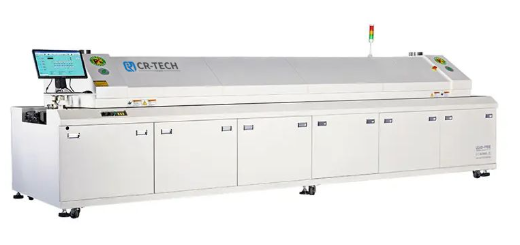
In the world of Surface Mount Technology (SMT), the reflow oven is the final frontier. It is where the theoretical design meets the physical reality of solder paste metallurgy. For engineers and production managers, the reflow oven is not just a machine; it is a precision instrument that requires meticulous control.
One of the most common misconceptions in the industry is viewing a reflow oven as a single "hot box." In reality, a modern reflow oven is a system of distinct climatic zones, each with a specific chemical and physical purpose.
To achieve a defect-free soldering process—eliminating head-in-pillow defects, tombstoning, or voiding—we must respect the function of these four primary thermal zones.
Here is an expert breakdown of the four core zones of a reflow oven and their critical roles in the assembly process.
1. The Preheat Zone: The "Ramp-Up"
Temperature Range: Ambient to ~170°C
Duration: 60-120 seconds (Heating rate typically < 2°C/sec)
The Function:
The preheat zone is the gentle awakening. Its primary goal is to raise the temperature of the entire PCB assembly uniformly. However, the critical function here is solvent evaporation. Solder paste is composed of metal particles mixed with flux and binders.
When the board enters the oven, the temperature must rise slowly enough to allow the volatile solvents within the solder paste to evaporate gradually. If the temperature ramps up too quickly, the solvents boil violently, causing "solder balling" and "splatter" outside the pad area.
Why It Matters for Your Production:
A stable preheat zone reduces thermal shock. Boards with large mass differences (e.g., connectors next to small capacitors) need this time to homogenize the temperature. Without a proper preheat, the board will warp, and components may experience "tombstoning" due to uneven expansion.
2. The Soak (Thermal Equilibrium) Zone: The "Activation"
Temperature Range: 170°C to 200°C
Duration: 60-120 seconds
The Function:
This is the chemical heart of the process. At this plateau, the temperature stabilizes, allowing the entire assembly to reach thermal equilibrium. More importantly, this is where the flux is activated.
The flux's job is to remove oxidation from the pads and component leads to ensure a clean metallic surface for the solder to bond to. The soak zone ensures that the flux has enough time to perform this de-oxidation process.
Why It Matters for Your Production:
If the soak is too short, you risk "cold joints" or "non-wetting" because oxides are still present on the pads. If the soak is too long or too hot, the flux can completely evaporate before the solder melts, leading to oxidation during the actual reflow process. Our equipment offers precise thermal stability in this zone to ensure your flux lasts exactly as long as needed.
3. The Reflow (Spike) Zone: The "Melting Point"
Temperature Range: Peak temperature 235°C to 250°C (Lead-Free / SAC305)
Duration: 30-90 seconds (Time Above Liquidus - TAL)
The Function:
This is the climax of the process. The temperature rapidly accelerates to the peak, pushing the solder paste beyond its melting point (approx. 217°C for lead-free alloys). The solder transforms from a solid paste to a liquid state (wetting).
This liquid state creates the intermetallic compound (IMC) between the component lead and the PCB pad. The IMC is what creates the mechanical strength and electrical conductivity of the joint.
Why It Matters for Your Production:
The challenge here is the time above liquidus (TAL) . If the TAL is too short, the solder does not fully melt, resulting in "cold joints." If the TAL is too long, it can cause brittle IMC growth and pad lifting. Our advanced thermal profiling technology gives you the control to hit the precise peak temperature required, ensuring robust, shiny joints without damaging heat-sensitive components.
4. The Cooling Zone: The "Solidification"
Temperature Range: 220°C to Ambient (Target: < 4°C/sec cooling rate)
Duration: Controlled descent
The Function:
The cooling zone is often overlooked but is equally vital to reliability. The board must be cooled down rapidly but safely to solidify the solder joints. The cooling rate determines the grain structure of the solder.
A controlled, rapid cooling rate (typically 3°C to 4°C per second) produces a fine, tight grain structure, resulting in a strong joint. Slow cooling allows the formation of large, brittle crystals and increases the risk of "pad cratering" or separation.
Why It Matters for Your Production:
Efficient cooling reduces the time the PCB spends at high temperatures, protecting the board and components from heat damage. It also prevents the movement of components via convection currents while the solder is still liquid.
Why Choose Our Reflow Equipment?
As an SMT equipment supplier, we understand that data is king. A reflow oven is only as good as its ability to maintain the integrity of these four zones.
Our latest generation of reflow ovens utilizes:
-
Independent Zone Control: Each of the four zones (sub-divided into top and bottom heaters) can be controlled independently to prevent thermal shadowing.
-
Closed-Loop PID Control: Ensuring that the temperature variance across the width of the conveyor is less than ±1°C.
-
High-Velocity Hot Air Impingement: Ensuring sufficient heat transfer to heavy, complex boards while maintaining the delicate thermal balance in the soak zone.
The Takeaway:
A successful SMT line is not just about speed; it is about thermal process control. When you understand the distinct roles of the Preheat, Soak, Reflow, and Cooling zones, you eliminate guesswork.
If you are looking to reduce your defect rate and improve throughput, it is time to upgrade to a reflow system that offers granular control over every degree of the curve.
Contact our technical support team today to get a free thermal profile analysis for your current product line. Let’s fine-tune your process and elevate your yield to 99.9%.